

7 Client Communication Skills You Need to Be an Expert Pet Sitter
Lots of people start pet sitting as a way to spend time with animals, but they quickly learn that there’s a lot more to the job than just walking dogs. What sets you apart and books more clients are skills like resume building, marketing, and clear communication.
When you start to behave more professionally, it can open doors to increased repeat clients, a reputation as an entrepreneur, and the opportunity to make more money. If you really want this to be a career, you have to be more than just good with dogs. But the good news is, these are skills you can learn!
At G&G Pets, we work with the best pet sitters that the San Francisco Bay Area has to offer. Here are 7 ways you can transform your communication skills and become the kind of pet sitter clients can’t wait to book again.
1. Professionalism
This applies to your written and verbal communication, as well as how you dress and conduct yourself around both clients and their pets. Everything about the way you present yourself needs to instill trust in current and prospective clients.
Keep your language more formal and professional. Be warm, but avoid being overly casual, and of course, avoid saying anything you wouldn’t say in church, to your boss, or to your school principal. When writing, double-check for coherence, spelling errors, spell out words completely, and keep emoji use to an absolute minimum. It can be helpful to develop some clear checklists of information to go over with clients, both to show your professionalism and stay organized.
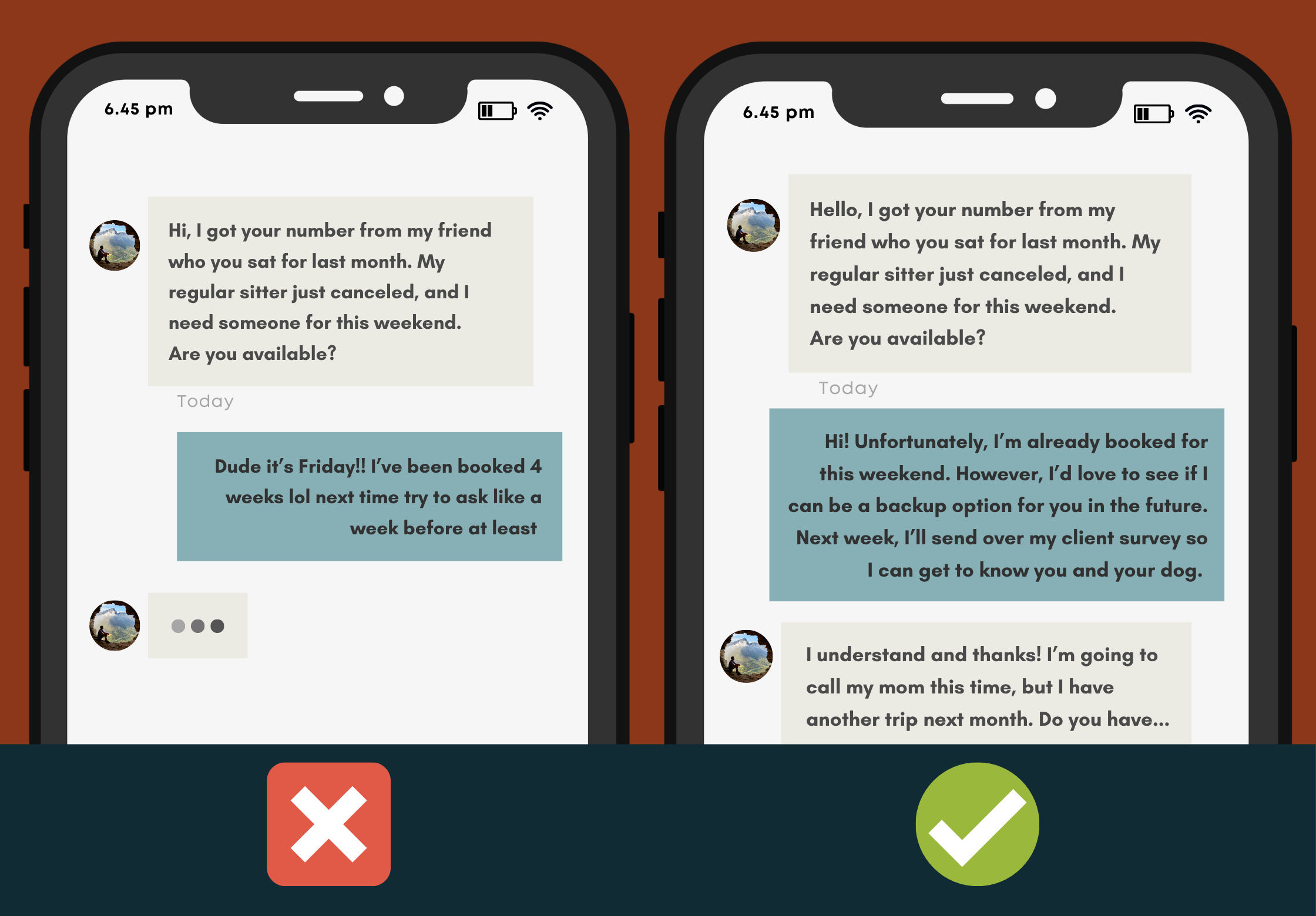
Don’t forget to dress the part.
When meeting clients, your outfit should be clean (and not overly wrinkly) and in good condition. It should look nice, but doesn’t need to be overly fancy. You’ll also likely be playing with the dog a bit, so make sure to wear shoes and clothes you can move comfortably in.
It should also go without saying, but never show up to work as a pet sitter drunk or high.
2. Organization
You need to have organized systems to keep track of clients’ information, including when and how you contact them. Be sure to store their information in a way that is secure but easy to reference when you need to use it. This can be overwhelming to build from scatch, so working with a pet care provider who can help handle these details for you is the way to go when you’re starting out.
Build out schedules for the ways that you contact or interact with clients (booking confirmations, daily check-ins, social media, promotional offers) so they know when they can count on hearing from you. (It never hurts to set alarms, too.) Getting organized is the key to two other aspects of productive communication: consistency and reliability.
3. Closing Sales
This can be the hardest part for some sitters, but once you connect with a new client — you have to actually pitch your services. It’s important to become more comfortable with sales tactics if you want to grow your business.
Start with developing a few short scripts that cover your experience and what you’re able to offer as a professional pet sitter. Practice them with friends or family until you're comfortable talking about your business with potential clients.

4. Marketing
Your past clients can be your easiest new bookings, but only if you ask. Put together an email newsletter reminding them about deadlines for the next holiday or a promotional discount for your slow periods.
5. Active Listening
This skill teaches you to pay closer attention to what clients are saying, with the goal of truly understanding and responding to them. The goal is to create long-term business relationships.
The basic cycle of an active listening session is:
Recognize the Unsaid | Acknowledge that you don’t currently understand a directive or situation fully, and be willing to take on new strategies or care approaches. Don’t assume your client’s innate, instead try to start the conversation without judgment.
Seek to Understand | Set aside biases and preconceived ideas on what the “best” type of pet care is. Ultimately, as a pet sitter, your role is to replicate the client’s care style, not change it. Center the experience on your client, rather than yourself. Approach the situation with curiosity and an open mind.
Decode | Present your new understanding in terms of active steps you can take toward resolution. Allow for corrections to your interpretation and plans. After the convo, send an email that recaps the situation as you understand it, your steps to move forward, and anything you need from them.
Act | Take an action to improve or correct the situation, environment, or your interactions with the other person. Show them you mean what you say by following through on your promises and changing the way you conduct yourself around them.
Close the Loop | Touch back with clients again to make sure your actions have been beneficial. Thank them for being open to the conversation and working with you. Using a tool like Canva to make a quick and professional “Thank You” card can go a long way.
6. Constructive Feedback
You’ll need to give feedback to your clients at some point, whether it be routine updates or standards that need to be met to continue care. How you do it can make or break the relationship quickly. Learning ways to get your needs across while remaining warm and professional helps turn new clients into repeat ones.
Practice delivering feedback in ways that are direct, but kind. Present some actionable steps that they can take, and what you plan to do to support them as well. Don’t try to make assumptions about what they were thinking or wanted; just focus on what happened and how you want to move forward. Stick with the facts, not feelings.
The “Compliment Sandwich” is a popular technique, where you deliver feedback “sandwiched” between two compliments. But because it’s well known, try to keep from being too obvious or insincere with your compliments.
7. De-escalation
Active Listening and Constructive Feedback are typically best done in situations where everyone is calm and ready to work on solutions together. But once you’ve mastered them, you can take the next step to de-escalating stressful situations in the moment.
With all the prior steps in place, you will likely not need to de-escalate with a client, but these tools can be helpful if you’re dealing with a reactive dog in public and are de-escalating a situation with a stranger.
When attempting to de-escalate a conflict with a client, the basic steps are:
Stay calm. Your tone, expressions, and body language will set an emotional baseline.
Actively listen. Attempt to understand their experience and concerns.
Give feedback. Explain your position and set boundaries if needed.
Create a plan. Outline a path to allow everyone some cool-down time before acting.
How to improve your client communication skills as a pet sitter
Like most careers, the trick is to never stop learning. Here are three free options to continue growing as a professional pet sitter:
Crash Course: Business Soft Skills and Entrepreneurial Skills | These 18-episode playlists are all under 15 mins and packed with statistics, graphics, and animations. While they don’t offer certification, they do make adding these skills easy and fun.
Coursera Classes | They host a wide variety of free courses taught by professors and industry leaders. Make sure to check out the reviews of the class to see how helpful it’s been to others before enrolling. Some may offer official accreditation as well.
Grow with Google | Google has a suite of free, online certifications and (non-certified) courses available to anyone with a Gmail account. You can brush up on a lot of different business skills related to communication, client management, and marketing.
How to thrive as a pet sitter
Another good tip to improve your communication with clients is to use a platform that makes it easy to keep each client’s information on hand and provides a secure way of contacting them.
While there are a lot of client management systems out there, none were quite right for what you need as a pet sitter, so we built our own! Our clients fill out an extensive profile for themselves and each pet. As a sitter, you have access to this information 24/7 via our custom app. You can also contact each client through the app, allowing you to keep your personal contact information private.
If you’re a pet sitter with great communication skills in the San Francisco Bay Area, then we want to hear from you! You can learn more about our standards for professional pet sitters here, or use the button below to start the application process.

The information provided by Grand & Graham Pets (G&G Pets) on https://www.grandgrahampets.com is for general informational purposes only. It does not represent medical or training pet care advice. All information on the blog is provided in good faith; however, we make no representation or warranty of any kind, express or implied, regarding the accuracy, adequacy, validity, reliability, or completeness of any information on the blog. Under no circumstances shall we have any liability to you for any loss or damage of any kind incurred as a result of the use of the blog or reliance on any information provided on the blog. Your use of the blog and your reliance on any information on the blog is undertaken solely at your own risk. All text content of this blog is the property of Grand & Graham Pets and is therefore subject to copyright protection and not for reproduction or reuse. By accessing or using the website, blog, any materials, content, or intellectual property owned by the Owner, you acknowledge and agree to the terms of this Disclaimer. For more information, please see our full Disclaimer.
